The Essence of Truth
and its Relation to Story
You have entered a realm whose birth succeeds its existence. No, we didn't mean to say precedes, we indeed mean to tell you that the period of time that this realm has existed is shorter than the length of its entire history. To understand this, we will need to strip ourselves of our preconceptions, toss out what we knew before reading this, and come to the table with a fresh set of eyes (ideally your own).
truth /tro͞oTH/ noun:
A story we tell ourselves to make sense of the world around us. Oftentimes in terms of relativity to other known concepts.
Yes and No
Imagine. An individual, a regal one at that, has a craving. We do not need to know who this individual is, just that they are royalty and therefore are accustomed to receiving that which they request, and that which they are requesting is an apple.
"Bring me an apple! I must have one at once!"
The regent waits, not for an uncomfortable amount of time. The regent is particular, but is aware of the expected amount of time that must pass before the regent's request may be fulfilled. After this not uncomfortable amount of time passes, a subject presents the regent with an item.
"An apple for you, high regent, as you requested."
Presenting it in a white linen wrapping, the subject displays in their hands a round, red fruit, with a rounded hexagonal form and a crown-like growth where it was plucked by the stem. Presented in a white linen wrapping before the high regent, who had requested an apple, is a plump pomegranate.
"What is the meaning of this? I had requested an apple! Not some bitter excuse of an approximation of one..."
...is how you might have expected this interaction to proceed. But, as storytellers, we can blur the lines between truth and falsehood, yes and no, right and wrong. And we do this by adding dimensions of truth. Consider: if ALL of the facts of the world were placed on a straight line, where the coordinate of a fact represented one unique statement, and each had a value of either "true" or "false."
If we found the coordinate point for "The regent requested an apple" in the context of this story, its statement value would be "true," because we have established it to be just so. We have also established "The subject brought the regent a pomegranate" to be true. Now, in the world as we know it, if we traveled further down the line, the phrase "The regent is satisfied with the knowledge that his request has been fulfilled" would be marked as false. But this is assuming that what we've been trained to know still applies.
At some point, "A pomegranate is not an apple" has been deemed as true. But what if it also wasn't? What if "A pomegranate is not an apple" could also be false? But narrator, then we would have two contradicting truth values for the same point on our line! Correct! Which is where we propose that truth has dimension. It is possible for truth to also be falsehood, as long as the proper dimensions and context are built around it. The only time two dots share a coordinate on a line yet have two different values is when there is an underlying umpteenth dimension that would give them separate identities.
Before we make this sound too complicated, thankfully this story has a simple solution. The term "apple," at its origin of use, was not used to solely refer to the fruit that comes from the tree known as Malus domestica, or whichever cousin of the apple tree existed at the time of the creation of the word "apple." "Apple" was used to refer to ALL fruits, and slowly after some linguistic prototype mumbo jumbo and a really long period of civilizational social development yadda yadda, "apple" evolved to refer to the fruit it evokes in your mind today. So, giving this story a linguistic dimension and flexibility to consider that a word you understand today may not mean what you think it means (just ask Inigo Montoya), we can end our short story with:
"This is much appreciated, dear subject. If you would be so kind as to bring me my paring knife?"
The Art of Storycraft
As storytellers, we must become experts in holding contradictive truths simultaneously. This may be easier said than done, though fictional genres like fantasy and science fiction would not have been able to be developed without this technique: they tell of protagonists who make possible the impossible, they describe incomprehensible horrors who only pose a threat when witnessed and comprehended, and they speak of the unreal made real.
Take for example the following hypothetical facts:
- "I killed them."
- "I saved their life."
While keeping the Agent and Theme constant (the actor and "actee", per se), there are several ways to add dimensions of truth to make these contradicting phrases simultaneously hold true.
We could, for example, add some specificity. Maybe the definition of "kill" in this circumstance, was entirely technical. A doctor who saves a patient during open-heart surgery must stop the heart and use a bypass machine. If one's definition of "killing" included stopping their heart, this may allow these two phrases to be true simultaneously.
We could instead add a dimension of relative time. One could feasibly save someone's life, and then also kill the same person. However, is it possible to switch the time relation? Perhaps the previous example could be stretched to be considered killing someone and then saving their life immediately afterwards, but narratively the two actions were part of the same process. We begin to see how fictional genres are born when we start to stretch the boundaries of our own understandings of the world. For one to kill another person through one act or process, and then save their life after some time has passed, we need to create a dimension of truth of our own. The power to bring back the long dead, though impossible in our world, is precisely the product of the practice we are proposing for transcendent fantasy storytelling: nothing is impossible so long as you extrapolate farther for new dimensions of truth.
An Entire World's Truth
Umbrea is not the world you'll be playing in. This preface is just a fancy way of preparing you for this fact. This world is a convergence of truths, where the pivotal contradictions were given new dimensions of truth to reach an equilibrium. "Umbrea" is just one of the two superimposed existences that now exist within the same dimensional sphere in the cosmos.
In the broad strokes of things, Umbrea exists within a larger cosmos, whose essence comprises the space between stars, the supposedly insurmountable space between different existences. These existences reside in places called spheres: spheres of influence, spheres of truth; these spheres contain within them a unique set of rules and defined truths that its contents must follow. Because of this, the setting of Umbrea is inclusive to other campaign settings that may not exactly follow the lore of the main campaign setting detailed in this guide.
In our sphere, the planet of Tsindwr (/'sin-dur/) is circled by a set of twelve moons of varying sizes, orbits, and compositions. Without a local sun to light the land of Umbrea, these moons and their backdrop of stars are the best way for scholars to keep track of the days and passing time.
These moons are some of the last remaining proof of the existence of the gods. Some say they first came to Tsindwr on these moons, some believe they built them when they arrived as their personal domains, and some suspect that the moons are the corpses of the dead gods themselves. What we do know of our world's first visitors, can be found in the mythos of an ancient elven civilization who later left Tsindwr to travel the stars.
The astral elves, or Shimylv, were the first to settle Tsindwr. What has been recovered of their history has either been restored from artistic reliefs, inferred from their arcane artifacts, or passed through word of mouth by their descendants. Their advancement in the mystic arts and astromancy suggests the possibility of other records of their civilization, though these methods of storing histories have yet to be discovered or decoded.
Their more base methods of records were oft reserved for their mythology, which is why we have record of the gods' few stories. This includes the events leading to their downfall: the conclusion to a war between the Divines and the Primordials. Originating from the adjacent planes of elemental chaos, the Primordials wanted Tsindwr for themselves: a playground of their destruction and constant rebirth. The Divines had other plans: a world of creation and evolution, something new to be perceived and discovered by its inhabitants.
However, a group of the Divines wanted to explore their destructive capabilities alongside the Primordials, and thus the Pantheon was split in two. Though a trickster god called Nlyoz-a, or The Light, knew a way to resolve this conflict, though at no one's benefit in particular. She had overheard Tbedw-na, or The Spider, speak of a ritual that could empower Tsindwr with the Divine souls, protecting it from further encroachment from the Primordials. Confident in her ability to finish the ritual, Nlyoz-a snuck into Tbedw-na's domain and stole the ritual texts.
The ritual required the cooperation of all of the Divines, and great sacrifice too, so Nlyoz-a devised a ruse. She added a clause to the ritual's final revision, and told both the Divines of Creation and the Divines of Destruction that this clause would protect them from the sacrifice needed by the ritual. Consulting with both groups at once, Nlyoz-a coordinated the ritual to be conducted contemporaneously from opposite sides of the world. What the rest of the Divines did not know, was that Nlyoz-a was conducting a third ritual, the final clause, in another location, and meant to only spare herself from the toll required by Tbedw-na's magic. She only intended to have Tsindwr for herself for a few decades before releasing her siblings, but her clause was flawed, and she ultimately needed to join her brethren in sacrifice to stabilize the final spell. In the end, all souls of the Divine were separated from their avatars, and imbued within the land of the Material Plane, imbuing it with a newfound planar boundary more stable and protective.
Scholars theorize that the gods now imbue the latent planar permanence of nature and its forces, though some theorize that they slumber in ancient tombs, dispersing their divine influence in radial areas around them. Skeptics are convinced they have been dead for a long time, and there's no use in waiting for their return.
Elfin Legacy
The Shimylv were the first to harness the dichotomic essences of Gloam and Faerie that permeate the world of Tsindwr. In most other spheres, the planes of the Feywild and the Shadowfell have been separated from the primary or Material Plane, however this is always done through the will of the gods. In Tsindwr, where the Divines are absent, the Material Plane still has its brightest and darkest aspects, giving its environment a polarizing and diverse level of magical infusion. Because of this, it is common for the innate nature of the land to imbue the living with consciousness and the dead with life. Much like the Feywild, one's environment can be influenced by one's mood, and much like the Shadowfell, the environment itself can influence its inhabitant's emotions. This made the land of Umbrea very volatile, and nearly uninhabitable, until the Shimylv introduced the Obelisks.
Great stone pillars with tapered tops were inscribed with constellations of arcane sigils and names, anchoring the nature of its surroundings to become stable enough to hold a single form, a single identity. The Shimylv were the first mortals to assign True Names to the land, quite literally setting them in stone to allow for stationary settlements and safe throughways. Without them, Umbrea was a roiling mass of whim and terror, where incorporeal presences haunted every shadow and mesmerizing swirls of enchanting spirits led wandering souls to their eternal entrapment.
For the most part, the evidence of the astral elves and their mystically-advanced civilization lives on in ancient abandoned cities carved of a singular stone structure. None have yet been able to reproduce the grandeur of their architecture, but there are those that search their ruins for enlightenment. Many of the names taken by large cities and assigned to major land formations are also influenced by the psychic presence of the True Names assigned to them by the Shimylv, though the passing of time has allowed them to shift and evolve with language. The last chapter of Shimylv civilization that we know of is their encounter with an intradimensional horror that leaked into Tsindwr, in the vast network of caves below the surface called the Kagecombs.
The entity was only ever pictured as a kaleidoscope of blank eyes, writhing tendrils, and dendritic mineral growths. It was never named or recorded in writing, so we will refrain from doing so in this recounting. What we can tell you is that the remains of this defeated entity were what fed the mineral growths in the depths below, and created a unique resource to be studied and harnessed by an elfin outpost that later became the dominion of Sauztein Geb. After sundering this entity, the Shimylv seem to all have left this plane for the stars; very rarely do these elves return to Umbrea but it has been known to happen occasionally.
Beneath the Footfalls of Titans
Millenia passed between the visitations of the Shimylv and the evolution of sentient anthropoid species, the first of which being the Mulburrows. The faerie essence of Tsindwr allowed for an advanced rate of evolution and change amongst its organic inhabitants, and was often influenced by the wills in its vicinity. This is likely why Mulburrows came to be during the Age of Titans. Lesser elementals from the Primordial Sea had found entryways into the Material Plane that were too small to allow Primordials to pass through but gave Titans such as giants and dragons a backdoor to explore a realm previously void of civilization. The presence of intelligent life was quite possibly the final piece required for the birth of the first unique race of Tsindwr.
The Mulburrow people were brought into the world while the elemental Titans attempted to shape and colonize the land. These fleet-footed smallfolk became quickly accustomed to using the nature around them to create camouflaged and portable shelters; they were always on the move. They began relying on the innate magics of the flora and imitating the practices of the fauna around them, slowly discovering a pattern to their formation and rituals. The Mulburrow civilization was the first to diverge from elemental magics and construct artificial spellcraft, through mimicry of nature's knowledge. They called the practice Weaving, and today they have perfected the craft of sewing arcane sequences into apparel, carving enchantments into materials, and coaxing plants into braided wards.
But it would be a long time before the Mulburrows could settle down in a haven of their own. Irachron was nigh and the elemental factions were on the brink of coups. In the beginning of the Titan's conquest of the Material Plane, each element found their own corner of the world. Giants and dragons of their respective factions lived in harmony for a period, building grand castles to house the planar crossings from where they came. Though over time, the essential Dichotomy of Tsindwr slowly sewed dissent between the two species; giants became obsessed with harnessing Gloam and dragons fell to Faerie's temptation to hoard the boons of the land. Both groups of Titans believed the other to be an obstacle to their goals; the giants would not part with their constructed keeps and dragons would not part with their understanding of the arcane. They were divided by their jealousy and ambition, thus beginning the Era of Rage and Storm: the Irachron.
War between giants and dragons ensued, lesser elementals were summoned as infantry and colossi called Wardens were built as harbingers of destruction. Giants became pioneers in the harnessing of Gloam's mutational properties; the phenomenon of enhancing natural fauna into colossal beasts of rending and craze was called Seep: the moment when a creature accepts the influence of Gloam to overtake their physical form and transmute into something more. Dragons took the first steps into golemic magicks and material alchemy, creating semi-autonomous constructs of inanimate material made animate through arcane sigiling and element-powered movement: as the dragons discovered new materials and methods of transmutation, they were able to optimize the composition of these golems for specialized purposes.
It was the discovery of Petrolune that turned the tides. Golems made from this material found in the ocean depths were observed to have unpredictable behavior, having disruptive and dampening interactions with arcane magic but would sometimes take unprompted autonomous action. Dragons who hoarded this material slowly became more and more seclusive, focusing on the understanding of this strange material. Petrolune golems seemed to learn, which was previously unheard of. Eventually, these golems started to go missing. Mulburrow legend, however, tells of voiceless visitors made of armor and barbs who showed no signs of life except for two glowing green eyes. These beings became historically known as The Heralds, and were the same beings that caused the end of the Era of Rage and Storm. Leading Mulburrow tribes across the world, these Heralds infiltrated giant strongholds and disrupted their protected portals, cutting them off from their elemental allies and leaving them vulnerable to the dragons' tyranny. The Mulburrows were essential for the downfall of the giants, providing the Heralds the necessary concealment and navigation through the strongholds, then slipping away unseen to leave the Heralds to complete the destruction of the portals.
After the strongholds were stripped of their wealth by the dragons and giants were driven into exile, the Mulburrows inherited the empty ruins and built multi-leveled communities and shelters from artificially-enforced wooden structures with a heavy incorporation of natural materials and high degrees of craftsmanship. Today, these strongholds are little-known, partially due to their strategic placement in the landscape, but also partially due to the Mulburrows' expertise in Weaving: they've had more than enough time to imbue a misdirection enchantment around their borders to protect from feral monstrosities.
If Umbrea were a single state, Drakonia would be its capitol.
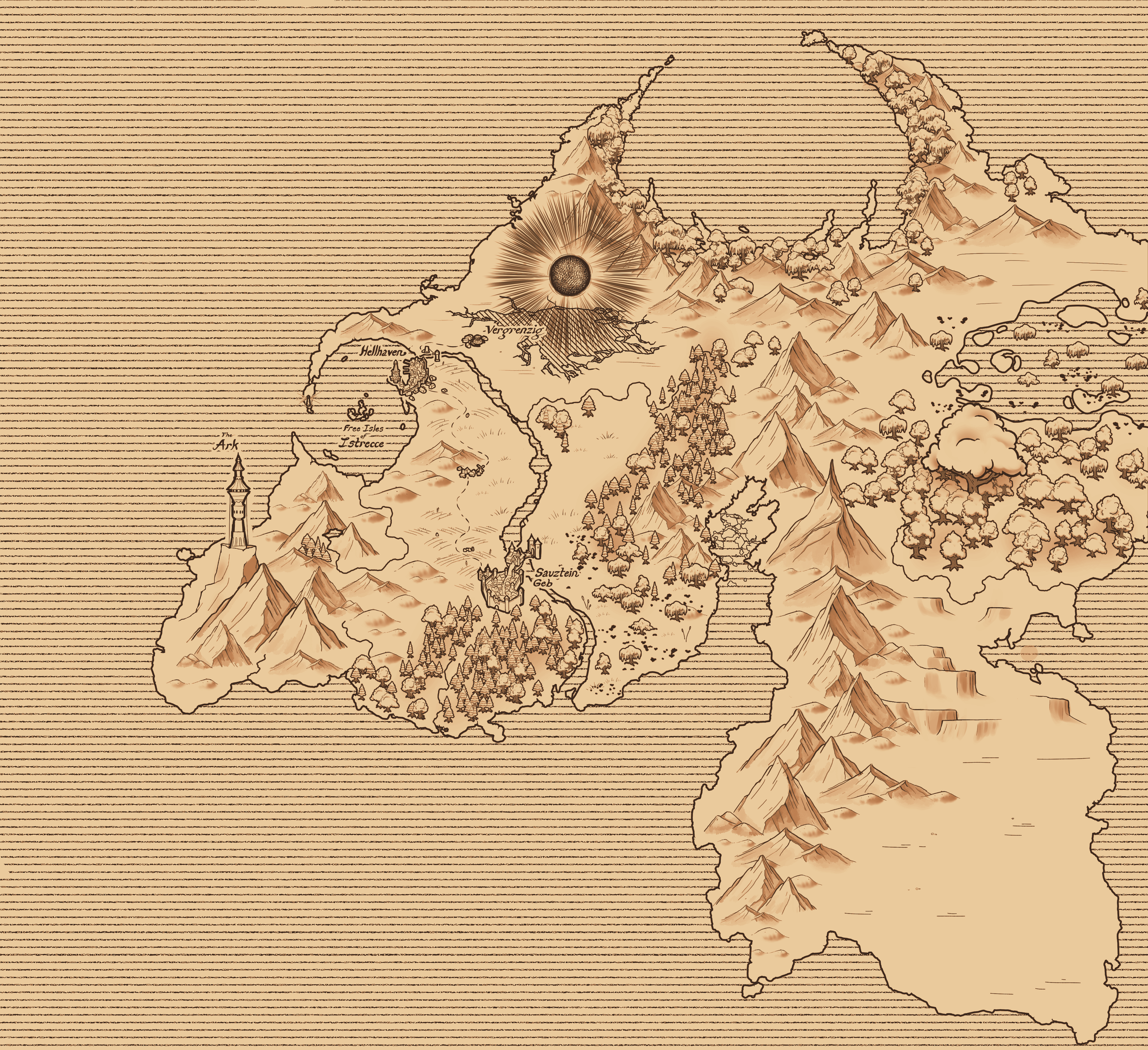
The story of the Irachron coming to its end gave way to the beginning of the Gnosichron, the Era of Known History. This was an era of draconic reign, arcane innovation, and the birth of the first true civilizations. The Empir Drakoni, or Empire of Dragons, was a sovereignty that spanned the entire northern half of the continent of Umbrea, and its capitol, Drakonia, was an island province in the center of an inland sea.
But 500 years before the end of the Era of Rage and Storm, the legacy of the Drakoni and its empire would begin in a single egg, shared by two brothers: Owalid and Oshik. Twin wyrms, they hatched to the warmth of their mother's hoard being melted down by the elemental glyphs of attacking giants. Bound by blood and fueled by revenge for their slain mother, Owalid and Oshik were the first of the dragon Titans to brush away their pride and work together. It was their final attack on the giants that drove home the nail that cemented the Gnosichron into stability.
It was these brothers who established the first settlement of what would become the great Empir Drakoni. This was a haven to conscious reptilians of all sorts, including humanoid Faerfolk (awakened anthropomorphic beastfolk), as well as even a slow trickle of minor dragons who let go of their independence in favor of communal benefits. As the settlements grew, leading proud Titans such as dragons became an increasingly difficult group to manage, let alone lead. They needed direction, a common goal. So Owalid and Oshik decided to give them one.
Drakkonia would become the greatest arcane hub of knowledge and innovation that Umbrea has ever seen. The pursuit of understanding the fabric of magic, The Arras, and the extrapolation of its patterns through implemented equation became the focus of dragonkin all over. Moving beyond golemic magic, the Empir Draconi became notorious for its infrastructural enchantments, the most notable being the aeropolises. The first aeropolis, or city of the sky, was made from the summit of the island's volcanic peak, rotated upside down and fueled by its elemental connection to the plane of fire. Later iterations of the aeropolises would no longer have such a reliance on the elemental planes, but Drakonia's sister city of Dwoemer's name would go on to represent all artificial arcane enchantments: a herald of esoteric accomplishment.
The Fall of an Empire
The first public signs of civil restlessness arrived with the establishment of the Drakonic Arena. Gladiators throughout the realm were called upon to provide entertainment with the prospects of earning a place in Empir Draconi's high militia. In an attempt to quell internal dissent and desire for new leadership, Owalid and Oshik, alongside their council, designed the battle arenas as a way to recruit the strongest among the populace while offering the common folk regular entertainment.
Seeds of doubt were sewn in the public opinion when the brother emperors, who until now had been known to be immortal, became one emperor: Oshik had disappeared from public view. With little explanation to the reason behind his stepping down from the throne, there was now concerns about both the longevity of their rulers, as well as the question of their successors.
There were many who believed the next line of emperors should be chosen, but there were many differing claims. The most notable candidate was a shimylf by the name of Valen Searcher, who dubbed himself The Sapphire King. A leader in his own right, The Sapphire King was the face of a large astral colony of elves and ingratiated himself to the Drakoni people through the Drakonic Arena. He rose through the ranks and graduated to a senior officer of the crown's guard. By then he had amassed a following and now had the numbers to challenge the throne.
Disaster struck before reform could even take a breath. Valen Searcher, The Sapphire King, quickly pivoted to exodus by sea, speaking of a great calamity on the horizon. "The sun would take a final breath and give way to an age of darkness and terror." Some believe his proximity to the emperor gave him insight to a dangerous arcane experiment whose repercussions would wrack the realm to its core. Some thought it was an attempt to bring his brother back from the dead. Some posited it was the last throes of a ruler desperate for ensured immortality. Some claimed it was not Valen, but his wife, only ever referred to as Nonna Rossa, who foretold the coming of a doomsday.
Drakonia sunk into the bowels of the earth. The Viridian Sea drained into the writhing trails of caves below. The fingers of magmatic vessels steamed and hardened. Steam clouds burst forth from cracks in the ground. Smoke clouds filled the sky, blotting out the light. The wards and siphons of elemental planar crossings became unstable, sending their tethered sister cities plummeting whence they came.
Dwoemer itself was never reported to crash. In fact, no evidence of its residents survived the fall of Empir Drakoni. What was left behind was a black sun that drained the heat of the entire north, leaving a frigid desert where the empire once stood proud. Most survivors of the fall were those who heeded The Sapphire King's warning, and took Llewyr Fenest and the western ocean beyond to cultivate a fresh start.
The Forewarned Slumber of the Surface World
The Arras was torn and frayed the day the empire fell. Magic was turbulent, and planar crossings became naturally unstable. Soothsayers and seers alike predicted a time of storm and prepared their communities for shelter. The chaos and spirits of the primordial planes burst forth and brought storms upon Umbrea.
Columns of fire raged under searing eyes glaring just behind the clouds.
Hungry vortexes swallowed boats and Colossi then whipped their remains onshore.
Wind bore through the mountains and landscape at dizzying speeds, carving through the land and shaping it to its image.
The world cracked and strained and shifted, digging deeper and deeper into the earth, crushing paths to make way for more who harbored the whispered breathing of titanic and lurking presences.
During the Tenechron, escaping to the Kagecombs below was the only path to survival. The faerfolk, Shimylv, titanblood, mulburrows, and what little Drakoni there were left retreated to the cave system below the surface, where most storms could not reach them. Lifetimes spent in the dark confines of the underworld gave rise to a shared language, and a generation of new races to claim this world as their own. The ever-moving progression of Faerie created a lineage of cave-dwellers adapted to their new home. Gnomes, dwarves, dark elves, and kobolds quickly made a home of their circumstances, carving dwellings from the host rock itself and gibing birth to the first sparks of now prosperous civilizations.
"Upon an Ark does she come, and in her hand the blazing starlight of The Lord"
Humans are visitors to this world, immigrants from a foreign land. Just like us. In Umbrea, they came on an Ark, following the steps of a brilliant arcanist. She who transported a people in search of refuge from a dying world: a prophet of possibility and a future. With them she brought the word of The Lord, a pioneer in a godless world.
With their advanced understanding of magic and its schools, the wizards of the Ark brought structure to those communities they touched, and most miraculous of all, their resolution of planar instability that paved the way into the Divine Age, the Luxichron.
Granted, the people of Umbrea never wanted for a god, and had spirits aplenty to rely on and deities of their own to organize around. The introduction of new god was no great ordeal, though one who could bring mass miracles was indeed. The Lord's devotees took residence in the Kagekunan city of Gellhapfen, and made significant contributions to the establishment of its surface world city. Here, the Concordat of Chains was formed, bringing order to a fresh haven from the hellscape of storm and cold destruction.
Not much is recorded of the specifics of The Lord, its origins, or its magic.
The Dread
This sphere is in flux. That which has been recounted here is no different. A collision of existences has brought the world into an equilibrium ever so slightly different from its original.
Very few are those who are aware of the changes made during The Dread, The Convergence, whatever you like to call it. Those who do are the ones with potential to lessen this world of its grievances. The Luxichron is yet to be defined by its events, nor those who live in its era. An equilibrium benefits those who settle for constance, yet it neglects that which still plagues its roots. Agents of change: those willing to step back and reconsider their world are those who we must rely on now.
The outlook is grim, but perhaps you are enough to change that.